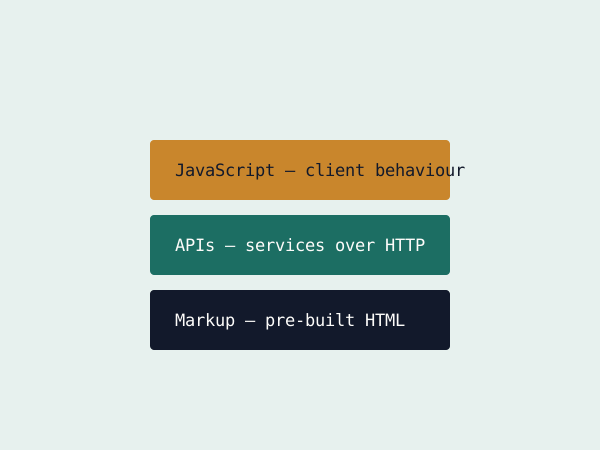
All three tools solve the same core problem - build HTML once, at deploy time, instead of on every request - but they reach for it from different backgrounds, and that shows up in what each is best suited for.
Jekyll: simple, Ruby-based, GitHub Pages native
Good fit for a documentation site or a simple blog where the content is mostly Markdown and the build doesn't need to touch a component framework at all.
Hugo: built for speed
Written in Go, Hugo builds thousands of pages in seconds rather than minutes - the clear choice once a content site's page count gets genuinely large.
Gatsby: React-powered, GraphQL data layer
export const query = graphql`
  query { allMarkdownRemark { nodes { frontmatter { title } } } }
`;
The right pick when a project needs real interactivity built with React components, not just static content, layered on top of the static build.
The same core idea, three different trade-off points
Gatsby's GraphQL data layer is powerful for pulling from many sources at once but adds real build complexity and a steeper learning curve. Jekyll, being older and Ruby-based, is simple and well-documented but slower to build large sites and less actively evolving. Hugo's Go-based builds are dramatically faster than either, at the cost of a templating language (Go templates) that's less familiar to most JavaScript developers.
# Rough build-time comparison, 1000-page site
# Hugo:    ~1s
# Gatsby:  ~60s+
# Jekyll:  ~30s+
Build speed matters more than it seems until it doesn't
A five-second build is a non-issue during early development; a five-minute build on a 5,000-page content site turns every content change into a genuine wait, which shapes editorial workflow far more than any templating feature does. For content-heavy sites expected to scale, we weight build performance more heavily than the data-layer flexibility that made Gatsby attractive early on.